



What is the Process Free (or Processless) Plate and What to Consider When Switching?
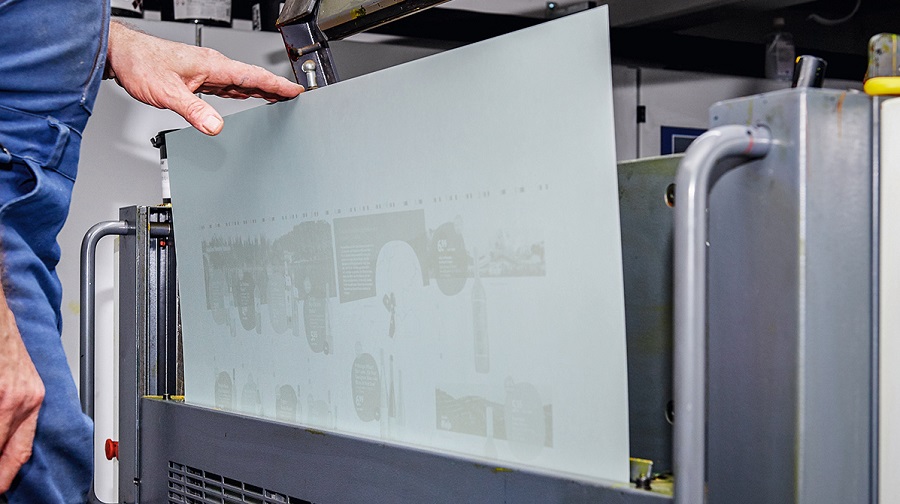
Photo Credit: Kodak Sonora Process Free Plates
Offset printing plates are the foundation of offset printing and are used to transfer image information from the plate cylinder to a rubber blanket and ultimately to the printed substrate. While conventional offset printing plates require a processing step after imaging, newer technologies such as processless plates (process free plates), and chemistry-free plates eliminate or significantly reduce this additional processing.
For commercial printers, packaging converters, newspaper printers, and other offset operations, selecting the right offset printing plate can impact print quality, consistency, operating costs, sustainability, and overall production efficiency.
Since the introduction of the CTP (Computer to Plate) plate from AGFA in 1993, it only took 2 years for more than 50 CTP systems to be brought to the DRUPA exhibition held in 1995. Nowadays, if you walk into a litho offset shop, you will definitely find a CTP system somewhere, usually in a separate CTP room or sharing space within the prepress department.
Just like any equipment you find in a manufacturing site; the CTP system needs a dedicated, trained, operator to run and maintain it on a daily basis. For the conventional CTP plate, after the raw plate is lasered by the imagesetter, it needs to go through the plate processor for “developing”, which removes the coating from the non-printing area after the raw plate was exposed to the laser. This process involves a few variables to look for to ensure the quality of run-ready plates. Common issues with the plate processor are: banding due to a weak chemical developer, undesired marks on the plate due to a hard (old) processor brush, plate coating damage due to uneven brush pressures sets, chemical re-deposits due to poor processor chemical maintenance, etc. Troubleshooting the conventional CTP plate is beyond the scope of this article.
How Does Offset Printing Use Plates?
Offset printing relies on printing plates mounted on the plate cylinder of the press. In a typical CMYK workflow, separate offset printing plates are produced for cyan, magenta, yellow, and black. Additional plates may also be created for spot colors.
Let’s assume you have all the moving parts dialed in on your CTP system and the processed plate looks great. Here are a few questions to ask yourself:
- Have you done an estimate on all the consumables and labor you put in to run the plate processor monthly or annually?
- What if there was an option that you can totally eliminate the need for a plate processor filled with chemicals and also have the ability to mount the lasered plate directly on the printing press?
- What if you could eliminate the need to dump chemicals on a regular basis?
If your answers to the questions above leave you looking for other options, you might consider the process free (or processless) plate.
What Are Offset Printing Plates?
Offset printing plates are thin metal (typically aluminum) plates that carry image information during the offset lithographic printing process. The image areas attract ink while the non-image areas attract fountain solution, allowing the press to reproduce graphics, text, and images accurately.
In offset printing, the plate does not print directly onto the substrate. Instead, the image transfers from the plate to a rubber blanket and then onto the paper, board, label stock, plastic, or other material being printed. This indirect transfer is what gives offset printing its name.
How Are Offset Printing Plates Made?
Modern offset printing plates are commonly produced using Computer-to-Plate (CTP) technology. In this workflow, digital artwork is prepared in prepress, processed through a RIP, and then imaged directly onto an aluminum plate using a laser platesetter.
Traditional offset printing plates then move through a processing stage where the non-image coating is removed. Processless plates eliminate this separate processing step and can be mounted directly onto the printing press after imaging.
How to Make Offset Printing Plates
The basic offset plate manufacturing workflow includes:
- Preparing the digital artwork
- RIP software makes the color separation from the prepress artwork
- Imaging the plate using a CTP system
- Processing the plate if required
- Mounting the plate onto the printing press
There are a few plate vendors on the market that provide this solution to litho offset printers, such as Fujifilm, Kodak, Agfa, Ipagsa, Saphira, etc.
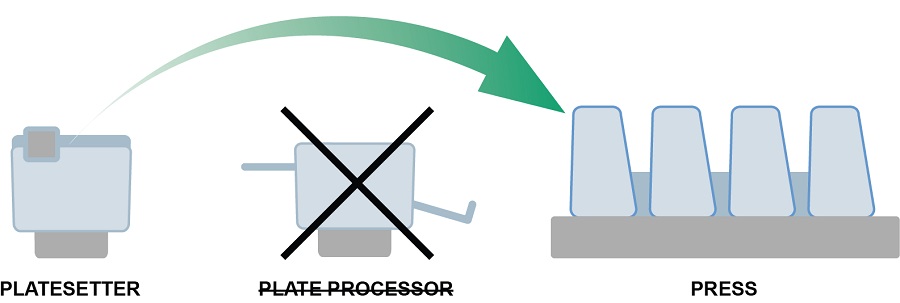
Process Free Plate Technology Overview
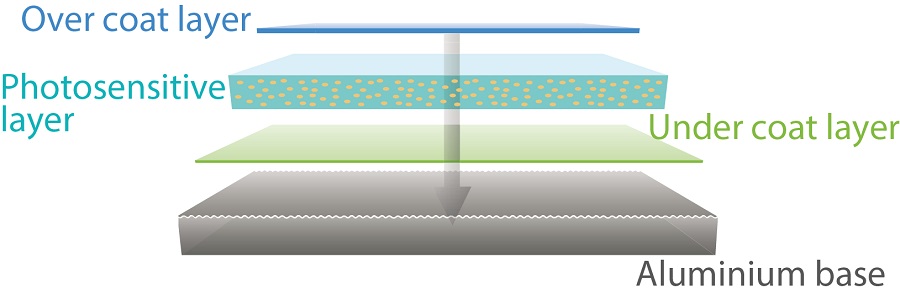
The diagram above shows the various layers of the Fujifilm Superia Pro-T3 process free plate, one example of a modern processless offset printing plate. These plate technologies help printers reduce dependency on chemical processing equipment while maintaining print quality and plate performance.
- Over coat layer: controls the diffusion of oxygen, ensuring optimum plate stability.
- Photosensitive layer: New Fine Particle Dispersion (FPD) technology improves the rate of fountain solution that penetrates the coating, speeding up the on-press start-up routine and improving on-press performance.
- Under coat layer: incorporates Rapid Stable Start-up (RSS) technology which helps to release the coating from the surface of the aluminum when the ink is applied.
- Aluminum base: new micro-graining process applied to the surface of the aluminum, guaranteeing the widest possible latitude in terms of ink-water balance on-press.
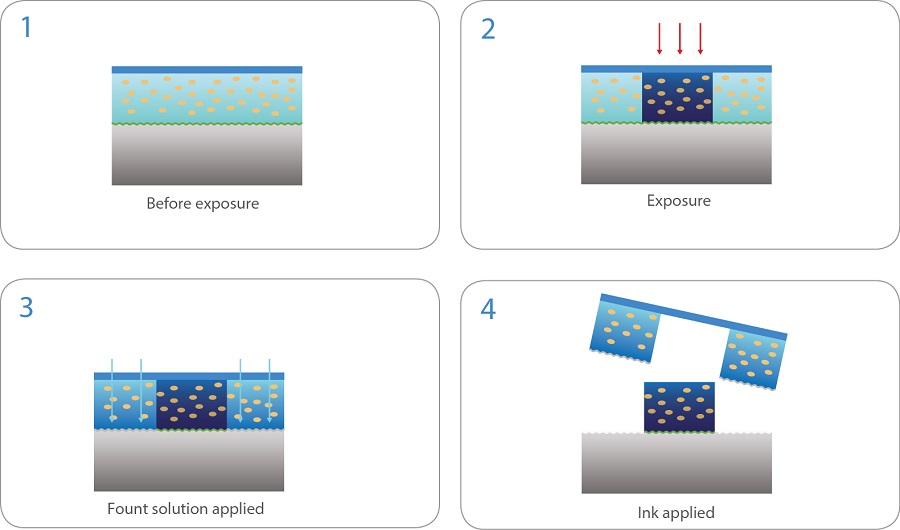
The above diagram shows how the Fujifilm process free plate works:
- Step 1 is the raw process free plate without exposure (out of box).
- Step 2 shows the exposure procedure of hardening the image area on the Process Free plate, highlighted in dark blue. Once exposed, the plate is ready to be mounted on printing press.
- Step 3 illustrates the effect of fountain solution being applied to the exposed Process Free plate and how it penetrates through the “soft” non-image area on the plate. Thanks to Fujifilm’s FPD & RSS technologies, the coating adhesion on the non-image area is further reduced from aluminum base.
- Step 4 depicts that after ink has been applied onto the Process Free plate, the plate coating layer is removed and now ready to print. Please note, the removed coating layer is deposited into the water/fountain solution pan and therefore you may need to increase the frequency of pan cleaning.
Kodak also has a fleet of Sonora Process Free plate products, here is the link to check them out.
The Benefits of Switching to the Process Free Plate
For many printing companies, the move from conventional offset printing plates to processless plates is driven by a combination of operational, environmental, and financial benefits.
Labor Savings: The conventional plate processor needs a dedicated trained operator to operate and maintain it. Regular work includes roller removal, cleaning rollers, scrubbing trays, mixing chemicals, filling jugs, repairing hoses, maintaining processor gears, etc. With the Process Free plate, it alleviates the burden from prepress employees so they can focus their attention and time on other areas within prepress.
Cost Savings: Besides the chemical consumables, which is one of the major expenses when operating a plate processor, there are huge savings on in plant utilities as well. The process free plate eliminates the extra usage of water and electricity that are required by a plate processor. Of course, there is no more cost for repairing and replacing parts for the plate processor.
Reduced Plate Room Variables: Conventional plate processors can introduce variability through developer strength, brush wear, processor maintenance issues, chemical contamination, temperature fluctuations, and inconsistent operating procedures. Process free plates eliminate many of these variables by removing the processing step altogether.
Environmentally Friendly: The Process Free plate requires no additional chemicals to develop before being mounted on press. Therefore, there is much less water pollution and printers can gain back the real-estate typically used to house plate chemicals.
The Trade-Offs When Switching from Conventional, Offset Printing Plates to Processless Plates
Start-up Paper Waste: For the conventional CTP plate, the ink transfer starts almost immediately on press startup; for the process free plate, (since there is no pre-development before the plates are mounted on press), the actual “developing” happens on the press. This means the top coat layer will be deposited into the water pan and also onto the paper with ink. Many of the Process Free plate manufacturers have claimed that their technology is very mature and that there should not be any extra paper waste other than the normal make-ready sheets needed for normal press operation.
Not so Visible Plate Image: After the process free plate is imaged by its imagesetter, the over coat layer and photosensitive layer remain on the plate. Therefore, the user won’t see much difference between the imaged & non-imaged areas on the plate. This could be a problem for the operators if they set the ink keys manually before press startup. It will take them a while to get used to the “not-so-visible” plate behavior before setting the ink keys correctly. But if there is an ink presetting system in place between the prepress department and the press room, this issue goes away.
Regardless of whether a printer uses conventional offset printing plates, chemistry-free plates, or processless plates, plate measurement remains an important quality control step. Measuring plate dots can help verify imaging quality before production begins and can help identify problems before they become expensive press issues.
If you still want to measure the process free plate after it is processed/developed, the Techkon SpectroPlate All-Vision offset plate microscope can be used. Techkons’s SpectroPlate All-Vision will need the user to hand-develop the printing plate using vendor recommended technique if measurements are needed before printing.
The SpectroPlate All-Vision has a number of unique features including:
- The device has custom profiles for over 100 plates from different manufacturers. The profile takes into consideration the sharpness/contrast of the dots of the plate, the background color of the plate, and the noise in the plate.
- It utilizes an IR light source allowing a better view of the low contrast dot, which is the norm for processless plates.
- It is widely used by most technicians of the three largest plate manufacturers; Agfa, Fuji and Kodak.
- The device is extremely reliable. It uses an LED light source and has no moving parts.
For printers evaluating new offset printing plates, the ability to accurately inspect and measure low-contrast processless plates can be an important part of a successful transition.
Plate Price and New Imagesetter: Process free plates may carry a higher unit cost than conventional or chemistry-free CTP plates. In some cases, transitioning to process free technology may also require investment in a compatible CTP imagesetter. But considering all the savings & benefits aforementioned, it seems to be a quite profitable investment with a high ROI.
Contact Us for Price and Delivery on the SpectroPlate >>
Submit a Request for Technical Assistance on the SpectroPlate >>