



Understanding Color Spectrophotometers in the Printing Industry
Color Spectrophotometers: Applications in the Printing Industry
Color spectrophotometers are indispensable tools in the modern printing industry. As the demand for high-quality, consistent color in printed materials continues to grow, ensuring that every print job meets customer expectations has become a top priority for print service providers. Whether printing packaging, labels, signage, or promotional materials, maintaining accurate and consistent color is crucial. This is where color spectrophotometers come in. These precision instruments help print professionals assess and control color reproduction throughout the production process, reducing waste, improving efficiency, and increasing customer satisfaction.
By measuring the intensity of light reflected from printed samples, spectrophotometers provide objective data that enables color correction and verification. This capability is vital not only for achieving accurate color but also for meeting industry standards and brand guidelines. With increasingly sophisticated printing technologies and growing expectations for color fidelity, having the right color measurement tools is more important than ever.
What Is a Color Spectrophotometer?
A color spectrophotometer is a scientific instrument designed to measure the amount of light that a sample reflects or transmits at different wavelengths across the visible spectrum. Unlike simpler color-measuring devices such as colorimeters, which offer basic RGB readings, spectrophotometers provide detailed spectral data that allows for highly accurate color analysis.
In the printing industry, this data is invaluable for maintaining color consistency and ensuring that printed materials match brand specifications. Spectrophotometers help achieve this by translating the light interaction with a sample into numerical values, which can then be compared to a defined color standard. The result is precise color matching and reproduction, regardless of substrate, ink, or print method. Whether for process control, brand color validation, or ink formulation, spectrophotometers are essential tools in the color management toolkit.
For print professionals, spectrophotometers for color matching serve as a foundation for delivering color accuracy that builds trust and confidence with clients, ultimately helping to drive repeat business and brand loyalty.
How Does a Color Spectrophotometer Work?
A color spectrophotometer functions by directing a controlled beam of light onto a sample and analyzing how that light is either reflected from or transmitted through the material. The instrument then measures the intensity of light at specific intervals across the visible spectrum—typically from 400 nm to 700 nm.
The measurement process begins with the selection of an appropriate light source, which emits a full spectrum of visible wavelengths. As this light interacts with the sample, some wavelengths are absorbed while others are reflected or transmitted. The spectrophotometer collects this reflected or transmitted light and passes it through a diffraction grating, which separates it into individual wavelengths. Sensors then measure the intensity of each wavelength, creating a spectral signature of the sample.
This signature is converted into colorimetric data using industry-standard color spaces such as CIELAB and can be compared against target values to determine if the sample is within acceptable tolerance levels. This level of accuracy is what makes spectrophotometers so valuable for critical color applications.
Key Applications in the Printing Industry
Color spectrophotometers are used in nearly every stage of the printing process, from prepress to final output. One of their most critical applications is in color verification—ensuring that printed colors accurately match the intended color. This is especially important for spot or brand colors, where even minor deviations can result in costly reprints or dissatisfied clients.
In quality control, spectrophotometers allow press operators to monitor color performance in real time. By taking readings during production, they can identify shifts or inconsistencies early, minimizing waste and improving overall print efficiency.
These tools also facilitate closed-loop color control systems, in which color measurements are automatically fed back to the press to adjust ink keys or density settings. Using systems such as Techkon’s PressLink, the result is faster makeready times, less manual intervention, and more consistent print runs.
Types of Spectrophotometers
There are several types of spectrophotometers available to meet different production needs. The most common types include handheld, scanning, and inline spectrophotometers, each suited for specific applications.
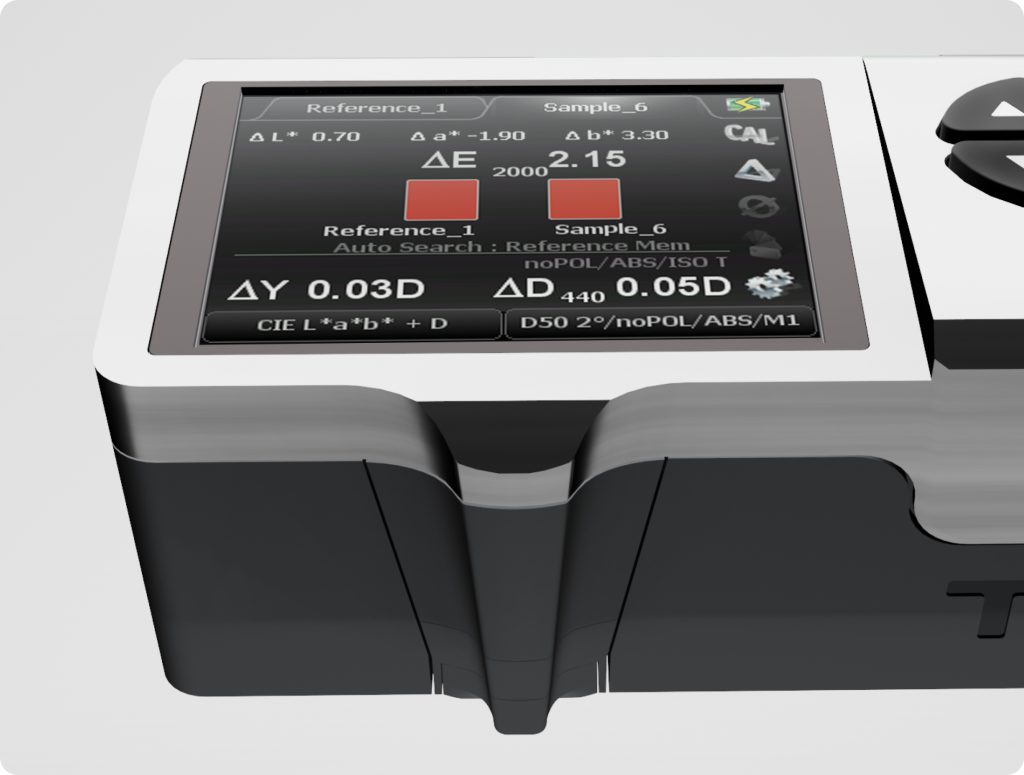
Handheld color Spectrophotometers are compact and portable, making them ideal for quick spot checks and on-the-go measurements. They are frequently used by press operators and quality control personnel who need to verify color without interrupting the workflow. Techkon’s SpectroDens is a popular example of a handheld device that is a combined color spectrophotometer and color densitometer to help control process, spot, Pantone®, or other brand colors.
Scanning Spectrophotometers are designed for higher-volume, automated measurement across larger print areas. They are typically mounted on precision tracks and used press-side. Techkon’s SpectroDrive and SpectroJet are two examples. The SpectroDrive is fully automated and ideal for offset presses, while the SpectroJet offers manual operation at a more economical price point. This device can be pushed along a precision track but can also be used as a handheld device for on-the-fly spot check measurements.
Inline Spectrophotometers are integrated directly into the press and are designed to take continuous measurements during production. These devices are critical for real-time color management in high-speed printing environments. Examples from Techkon include the 2025 FTA Technical Innovation Award-Winning SpectroVision, which is optimized for flexo, gravure, and digital presses; SpectroView, which is intended for industrial manufacturing settings and alerts operators before color drifts occur; and SpectroEdge, which integrates into OEM machinery.
Choosing the right type depends on your production scale, level of automation, and quality control requirements.
How to Measure Color with a Spectrophotometer
Accurate color measurement with a spectrophotometer involves a series of careful steps. First and foremost is proper calibration. Without calibration, even the most advanced spectrophotometer will provide unreliable data. Techkon simplifies this step with built-in calibration features:
- For handheld and scanning devices, calibration is performed using a white tile integrated into the charging base.
- Inline models like SpectroVision conduct automatic calibration as needed without user intervention.
- Techkon also provides free factory recertification under its Planned Maintenance Program (PMP), offering loaner devices during service periods. For inline devices, a technician will be sent on-site to replace the spectrophotometer with a loaner device while the original is sent to Danvers, MA to be recertified.
Next, the sample to be measured must be prepared. It should be clean, flat, and free of any defects that could distort readings. For flexible packaging materials, which may develop surface texture during manufacturing, Techkon’s SpectroDens includes polarization filters to eliminate glare and improve measurement reliability.
Finally, the sample is positioned correctly, and the measurement is initiated. The spectrophotometer captures and analyzes the light interaction, then generates detailed color data. Operators can compare this data to target values and adjust printing conditions accordingly.
How to Read Color Spectrophotometer Results
Reading and interpreting spectrophotometer results is crucial for maintaining color accuracy. Typically, results are presented as both spectral data and numerical values. Spectral data is shown as curves representing how the sample reflects light across the visible spectrum, while numerical data includes values like LAB and ΔE (color difference).
Delta E values are especially important, as they indicate the degree of color difference between a sample and a standard. Lower ΔE values mean closer matches, with values under 2.0 generally considered acceptable for most printing applications.
Understanding these results empowers operators to take corrective actions quickly, ensuring printed colors stay within specified tolerances. It also improves communication between departments and with clients by providing a common language for discussing color performance.
Color Analysis with Spectrophotometers
Color analysis involves more than just checking if a color is right or wrong. Spectrophotometers allow for deep insights into color behavior and can track how ink and substrate interactions impact the final result. With this data, operators can fine-tune press settings, adjust ink formulations, and optimize substrate choices.
Spectrophotometers are also useful in process control, where they help identify trends and prevent recurring color issues. By logging color measurements over time, printers can build a database of performance that aids in troubleshooting and long-term improvement.
The end result is better print consistency, reduced material waste, and improved customer satisfaction.
What Is the Best Color Spectrophotometer?
There is no one-size-fits-all solution when it comes to choosing the best spectrophotometer. The right choice depends on your specific needs, such as job volume, type of printing, available budget, and the level of automation you require.
Key criteria to consider include:
- Measurement accuracy and repeatability
- Ease of use and learning curve
- Software integration and reporting tools
- Maintenance and calibration options
Techkon’s SpectroDens is a standout for its versatility and intuitive interface, making it ideal for both beginners and experienced operators. For shops looking to automate press control, Techkon’s PressLink offers a closed-loop solution that automatically adjusts ink keys to maintain consistent color throughout a print run.
By evaluating your unique needs and understanding the strengths of different models, you can make an informed investment that improves both print quality and operational efficiency.
Conclusion: Maximize Your Color Management Investment
Investing in a high-quality color spectrophotometer is a decision that can significantly enhance your print shop’s capabilities. With consistent and accurate color control, you not only improve product quality but also build stronger relationships with clients who trust your ability to deliver every time.
To maximize your investment:
- Implement routine calibration and maintenance
- Train staff to interpret and act on measurement data
- Leverage software tools for better reporting and analysis
Stay informed on advancements in color measurement technology
Ultimately, a well-chosen spectrophotometer is more than just a quality control device—it’s a competitive advantage that supports long-term growth and customer satisfaction in the printing industry.