



Understanding the Basics of Color Management Systems
What is a Color Management System (CMS)?
A Color Management System (CMS) is a technology framework essential for the graphics arts and printing industries. It ensures that colors are consistent from digital conception to final print. This system enables various devices such as monitors, printers, and presses to produce uniform colors. At its core, a CMS uses ICC profiles to manage how colors are represented. Color profiles describe the color attributes of each device involved in the printing process. These profiles are standardized data sets allowing devices to communicate effectively about color.
Key features of a CMS include:
- Color consistency across multiple devices
- Reliable color reproduction from digital to print
- Standardized color profiles for accuracy
The CMS plays a pivotal role in color accuracy, a critical factor in high-volume printing. It ensures that the colors you envision in your design match what is ultimately printed, maintaining brand integrity and customer trust.
What Does a Color Mangement System Do?
In the world of printing, color accuracy is paramount. A color management system (CMS) is essential for achieving this precision. It ensures that colors remain consistent across different devices and media. This consistency is crucial for maintaining high print quality and meeting customer expectations across all print jobs.
Print shop owners often face challenges in maintaining color accuracy. A CMS addresses these challenges by providing predictable and reliable color reproduction.
For printing equipment purchasers, selecting the right CMS tools can be daunting. The right choice can enhance productivity and reduce costs.
Understanding the basics of a CMS is the first step. It can lead to improved operational efficiency and customer satisfaction.
Why is a Color Management System Needed in Printing?
You might be wondering, “What is the purpose of a color management system?” The answer is to maintain consistent and accurate color across different devices, in order to ensure quality across all print jobs.
A Color Management System (CMS) addresses the challenge of color variations across different print runs and devices. Without a CMS, achieving uniformity in color reproduction can be difficult and costly.
A CMS is essential for several reasons, including:
- Ensuring consistency across different print devices
- Reducing errors and reprints
- Enhancing customer satisfaction with accurate colors
Print shops use CMS to meet customer expectations by delivering reliable and precise colors. This consistency not only satisfies clients but also helps reduce waste and unnecessary reprints. By implementing a CMS, print shops can streamline operations and achieve more predictable results, ultimately reducing operational costs and improving efficiency.
What are the Core Components of a Color Management System?
A Color Management System comprises several crucial components working together to ensure accurate color reproduction. Each element plays a distinct role in managing and maintaining color consistency across different devices and media.
At the heart of a CMS are color profiles, which describe the color attributes of a device or media. These profiles ensure that colors are translated accurately from one system to another, maintaining fidelity and consistency.
Key components of a CMS include:
- Hardware: Instruments like spectrophotometers for color measurement
- Software: Applications for color calibration and profiling
- Standards: Guidelines like ISO and G7 for quality assurance
In addition, effective CMS implementation requires regular calibration and maintenance of the color measurement instruments. This ensures optimal performance and reliability. By integrating these components, a CMS can enhance workflow efficiency and improve print quality across the board.
What are the Three C’s of Color Management?
A Color Management System functions through a series of coordinated steps (“The 3 C’s”) designed to manage and control color reproduction. The process begins with device calibration, ensuring that printers, monitors, and scanners are operating within set parameters.
Next, characterization, or color profiling comes into play. This involves creating color profiles for each device using tools like spectrophotometers. These profiles help translate color information across devices accurately, maintaining true-to-life color representation.
The CMS uses these profiles to adjust and convert colors, ensuring consistency regardless of the device. Implementing a CMS can streamline the printing process, reduce color discrepancies, and enhance overall print quality. By maintaining color integrity, businesses can meet customer expectations and improve satisfaction.
The 3 C’s of color management are:
- Calibration: Setting a device to standard conditions.
- Characterization: Mapping the device’s color capabilities.
- Conversion: Translating colors between devices.
What is an Example of Color Management?
An example of a CMS is the MYIRO-1 Profiling Spectrophotometer. The MYIRO-1 allows users to create ICC profiles for color displays, build custom printer profiles, measure single swatches or color control strips, all done through 100% wireless operation.
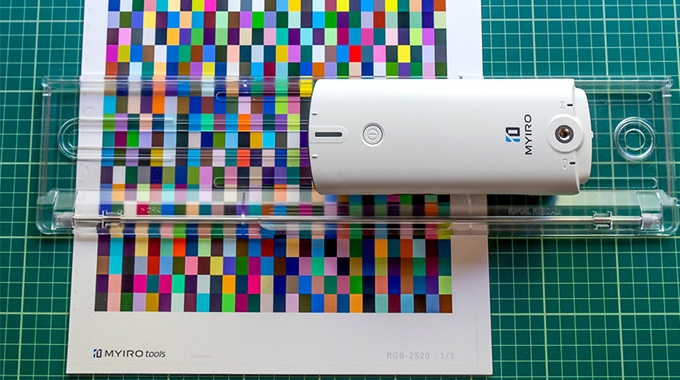
The MYIRO-1 comes in three configurations:
- Essential: Calibrate and build ICC profiles for all of the displays in your photo studio or prepress department.
- Profiling: Build ICC profiles for both your displays and color printers (RGB, CMYK, & DeviceLinks). Printer profiles can be created using several preset profiling options to remove the guesswork. The ideal combination for photographers and printers using inkjet and digital or analog presses.
- Advanced: Build ICC profiles for both your displays and color printers (RGB, CMYK, & DeviceLinks). The Advanced package is designed for printers who require complete control & customization of press profile color separation parameters, gamut mapping, and compensation for optical brighteners.
Key Benefits of Implementing a Color Managemnt System in Printing
Integrating a Color Management System in printing brings multiple advantages. It primarily ensures consistent color reproduction, a cornerstone of quality printing. Consistency builds trust and satisfies customer expectations.
A CMS also reduces waste, a significant cost factor in printing operations. By eliminating color errors, it minimizes the need for costly reprints. This efficiency translates directly into cost savings.
Here’s why a CMS is vital for print shops:
- Enhances color accuracy and consistency.
- Reduces waste through precise color management.
- Improves customer satisfaction by meeting color expectations.
Moreover, a CMS can improve workflow efficiency. By automating color management tasks, staff can focus more on production, not adjustments.
Choosing the Right Color Management Tools
Selecting the appropriate tools for color management is crucial for any print shop. The choice depends on several factors, including the type of printing, budget, and specific needs. Proper tools ensure accurate color calibration and profiling, essential for quality prints.
Key instruments in a Color Management System (CMS) include spectrophotometers. These devices measure and monitor color consistency. Different tools suit different setups, and it’s important to match them with your production goals. Techkon USA offers a range of spectrophotometers, such as:
- SpectroDens: The SpectroDens is an all-in-one SpectroDensitometer. This device combines the functions of a spectrophotometer and a densitometer while providing press operators and ink technicians with precision color control. The SpectroDens can measure solid ink density, dot area, CIE Lab, delta E, check G7 conformance, perform ink checks, and more. The SpectroDens can also be used to measure a variety of spot colors.
- SpectroDrive: The SpectroDrive is an automatic scanning spectrophotometer that runs along a precision track. The device can also be picked up and used as a handheld device for on-the-fly measurements and can scan a 40” press sheet in less than 8 seconds. SpectroDrive can be used with Techkon’s ExPresso software for a cost-efficient open loop system. It can also be used with Techkon’s PressLink as a fully integrated closed loop solution for offset.
- SpectroJet: SpectroJet is a lower cost (handheld) solution compared to the SpectroDrive. This instrument can be pushed along a precision track or picked up and used for spot check measurements. The SpectroJet can be utilized along with Techkon’s ExPresso software for an open loop solution for offset.
Evaluate the return on investment when selecting instruments. With precise tools, print shops can streamline processes and enhance color accuracy. Ultimately, effective tool selection contributes to improved productivity and customer satisfaction.
Best Practices for Effective Color Management
Implementing color management effectively requires adherence to best practices. These practices ensure consistent quality and color accuracy in printing operations. Regular maintenance of equipment and software updates is fundamental for sustaining performance.
Training staff on using the Color Management System (CMS) maximizes its benefits. Skilled users can efficiently handle color calibration and profiling tasks.
Consider these best practices:
- Schedule routine calibration of color measurement devices
- Use standardized color profiles
- Train staff on CMS tools
By following these practices, print shops can achieve reliable color management. This approach enhances overall print quality and reduces waste, leading to satisfied customers and optimized production costs.
The Future of Color Management Systems in Printing
The evolution of Color Management Systems (CMS) is pivotal for the print industry’s future. As printing technology advances, CMS innovations are crucial for adapting to new demands. Developments like AI-driven solutions and cloud-based systems are on the rise, promising enhanced color accuracy and automation.
In the near future, we might observe:
- Increased integration with digital printing technologies
- Enhanced automation features for seamless workflows
- Expanded capabilities for handling diverse print media
These advancements will empower print shops to maintain competitive edges by ensuring top-quality and efficient operations. Embracing these innovations will likely be essential for thriving in the ever-evolving print industry landscape.