



Spot vs Process colors: How They Work Together
What Is a Spot Color?
A spot color is a single, premixed ink designed to produce a specific hue. Unlike process colors that are created on press, spot colors are mixed before printing according to standardized color systems — most commonly the Pantone Matching System (PMS).
Example of a Spot Color
Imagine a brand that uses a deep, vibrant blue as its signature brand color — but it can’t be accurately reproduced with standard CMYK inks. When printed using process colors, this blue often appears duller or shifts toward purple because it falls outside the CMYK color gamut.
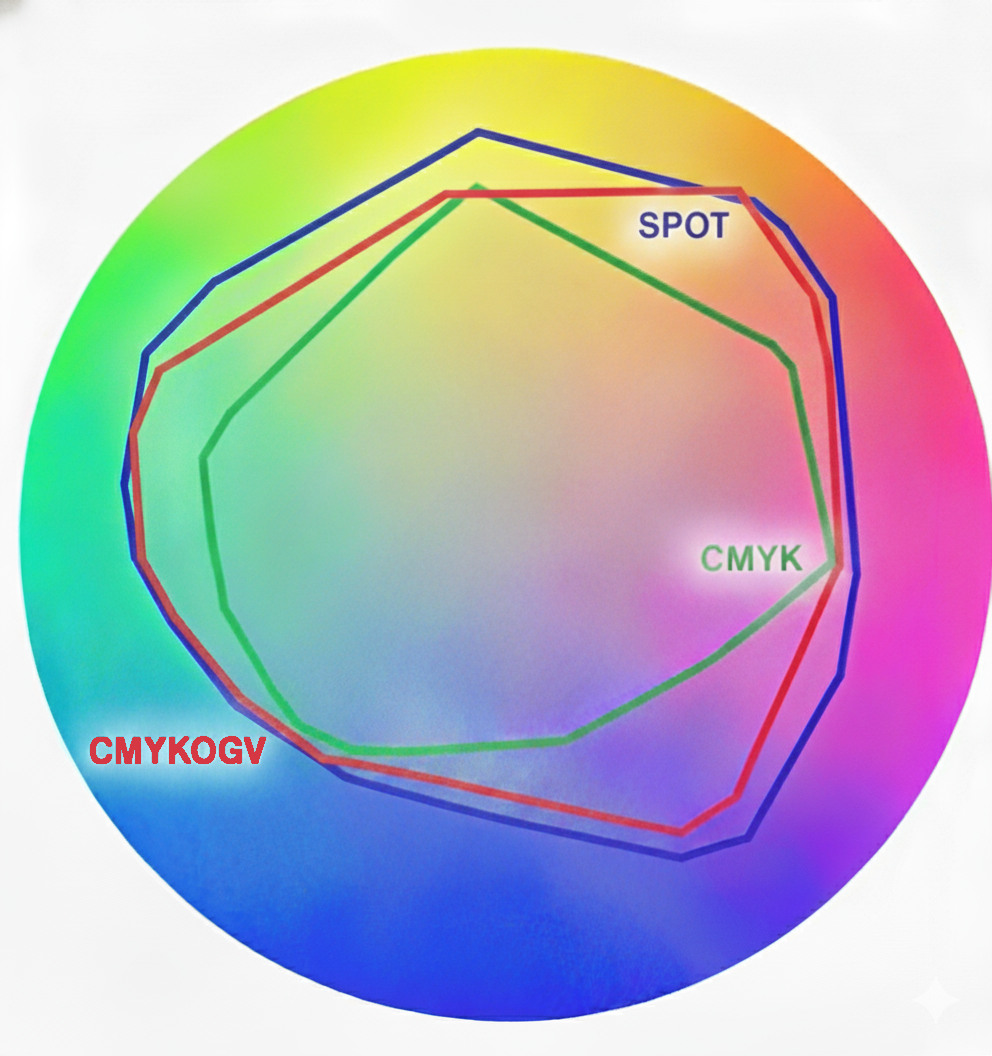
To achieve the true shade, printers specify it as a spot color — a premixed ink formulated precisely for that tone. Because spot colors are printed as individual inks rather than created by overlapping cyan, magenta, yellow, and black, they can better maintain brand consistency, even on different substrates.
When Should You Use Spot Colors?
Spot colors are ideal when:
- Brand color consistency is critical (e.g., logos, corporate identities)
-
- Because spot inks are formulated to an exact recipe, they deliver unparalleled precision and repeatability.
- The color is outside the gamut of CMYK (such as deep blues, bright greens, and deep orange).
What Is a Process Color?
Process colors refer to the standard CMYK (Cyan, Magenta, Yellow, and Black) printing model used in most full-color printing applications. These four semi-transparent inks overlap in tiny halftone dots to create the illusion of a wide range of colors.
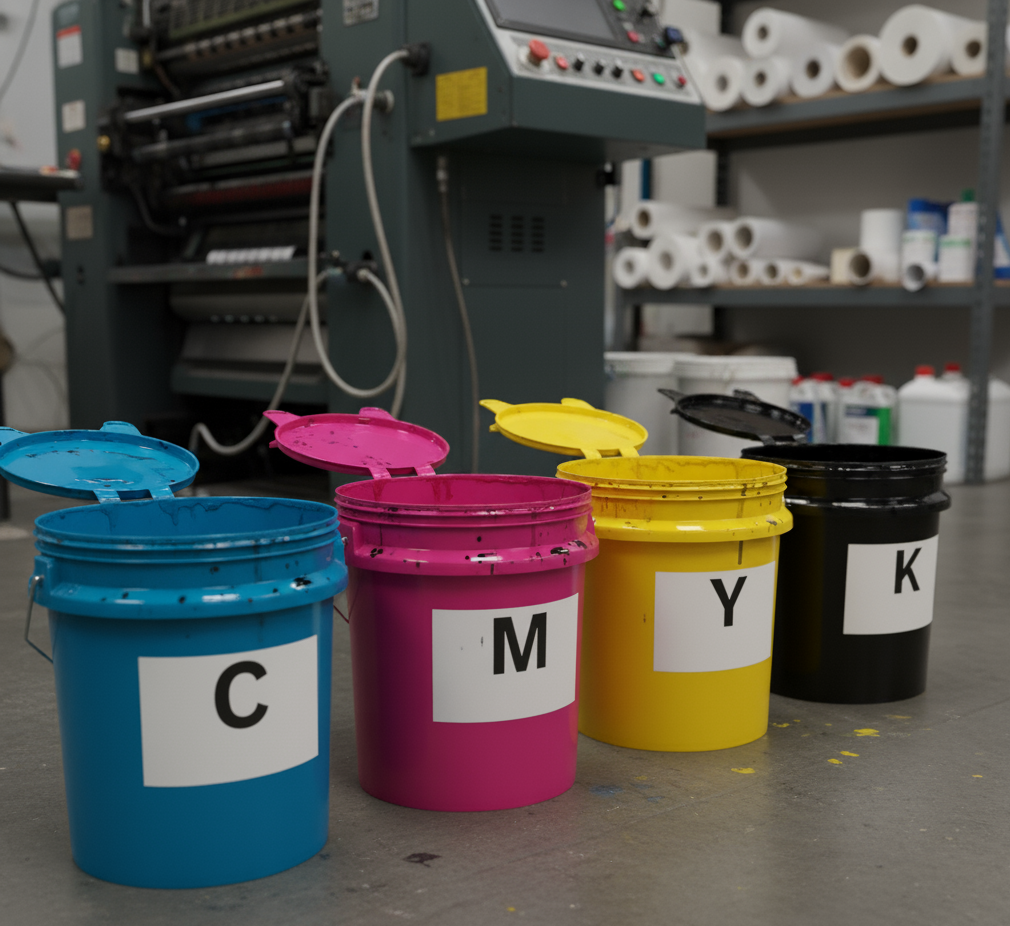
What Is 4-Color Process Printing?
In 4-color process printing, each color (C, M, Y, and K) is printed in layers using screens or plates. When viewed together, these dots blend visually to reproduce photographic images and continuous-tone artwork.
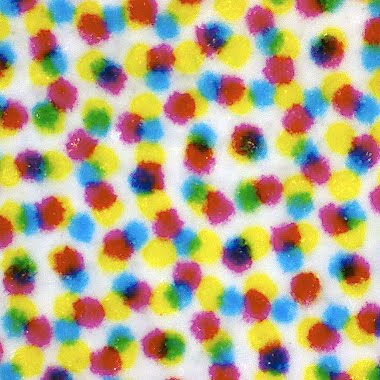
This technique is the foundation of most magazines, posters, and packaging designs that use full-color imagery.
When Is a Process Color Used Instead of a Spot Color?
Process colors are ideal for:
- Jobs with complex images or gradients
- High-volume runs where cost efficiency matters
- Projects requiring a wide color range rather than exact spot matches
While CMYK can reproduce most colors effectively, some brand or specialty colors may fall outside its gamut — which is where spot colors or extended gamut solutions come in.
Spot Color vs Process Color: Key Differences
| Aspect | Spot Color | Process Color (CMYK) |
| Ink Type | Premixed, solid ink | Semi-transparent inks overprinted to blend colors |
| Color System | Pantone or custom formulation | CMYK process build |
| Precision | Extremely accurate, consistent | Depends on press calibration and ICC profiles |
| Best For | Logos, brand colors, metallics, fluorescents | Photographs, gradients, full-color designs |
| Cost | Higher when multiple colors are needed | More efficient for full-color imagery |
| Reproducibility | Perfect consistency batch to batch | May vary slightly across devices or substrates |
How Spot and Process Colors Work Together
In many modern print workflows, spot and process colors are strategically combined — a method referred to as spot-process hybrid printing. This approach allows printers to leverage the broad tonal range and cost-efficiency of process printing (CMYK), while maintaining the color accuracy and brand consistency provided by spot inks.
For example, a typical production run may use CMYK to reproduce full-color images and gradients, while incorporating one or two spot colors for precise brand elements such as logos, corporate colors, or key accent areas that must match specific color standards. This hybrid technique offers the best of both worlds — delivering vibrant, photographic imagery alongside consistent, repeatable brand colors — making it a preferred solution for packaging, marketing materials, and other applications where both color fidelity and efficiency are essential.
Extended Color Gamut (ECG) Process Colors
Modern technology has introduced a new middle ground: Extended Color Gamut (ECG) or 7-color printing, which expands the CMYK process by adding Orange, Green, and Violet (OGV) inks.
Why It Matters
ECG printing increases the reproducible color gamut by up to 90% of Pantone colors, dramatically reducing the need for separate spot inks. By doing so, this method improves efficiency by minimizing ink changes.
With ECG, printers gain flexibility and consistency — but to make it work, accurate color measurement and calibration are absolutely essential.
The Technical Side: Color Management Challenges
When running CMYK or extended gamut (CMYKOGV) work, maintaining proper screen angles and dot overlap is critical to achieving clean separations and accurate color. For printers working primarily with CMYK and a few spot colors, a standard densitometer—like the Techkon DENS—might be sufficient for monitoring solid ink densities and dot gain, since the target colors are already defined.
However, once you move into expanded gamut printing, incorporating Orange, Green, and Violet inks, density alone isn’t enough. You need to know exactly what color you’re producing on press. That’s where a spectrophotometer, such as Techkon’s SpectroDens, becomes essential. It measures the spectral data of the printed patches, allowing you to confirm that your overprints are hitting the intended brand colors.
With spot colors, the main challenge arises when the color isn’t matching on press. Adjusting the ink by eye or trial-and-error wastes time and materials. Techkon’s ChromaQA with Smart Ink eliminates that guesswork. Using AI-driven color intelligence, SmartInk analyzes the measured data and provides precise guidance on how to tone the ink—so operators can bring colors into tolerance quickly and confidently.
How Techkon Helps Printers Manage Spot and Process Colors
Whether you’re working with spot, process, or extended gamut color workflows, the ability to measure and verify color objectively is the key to consistency and quality. Human vision is subjective — lighting, fatigue, and environment all influence perception — but instruments like the SpectroDens remove that variability, providing data-driven accuracy every time.
With Techkon’s portfolio of handheld and inline solutions, printers can:
- Validate spot colors against digital standards
- Ensure CMYK and ECG builds meet tolerance
- Maintain repeatable color across substrates, presses, and locations
- Maintain repeatable color across substrates, presses, and locations
The SpectroDens is a densitometer and spectrophotometer in one, giving you the ability to measure both spot and process colors with unmatched precision. It provides spectral data and pass/fail feedback — ensuring that every print run stays within tolerance.
The SpectroDrive is a press-side, automated, scanning solution for offset presses. This spectrophotometer runs on a precision track that can be ordered in lengths up to 81 inches.
The SpectroVision is an inline color measurement system designed for continuous monitoring on high-speed presses. It helps operators maintain color accuracy and consistency throughout the entire run — even at full production speed.
ChromaQA software delivers a comprehensive color quality control workflow. It streamlines spot color approval, ink kitchen formulation, and on-press verification, giving operators immediate visual feedback.
With ChromaQA, print teams can track both spot and process color performance in real time, improving efficiency, reducing waste, and ensuring customer satisfaction.
Together, these tools give print professionals a seamless color management system, connecting color specification, formulation, measurement, and reporting.
Conclusion
Understanding the differences between spot color vs process color is fundamental for any print professional striving for excellence.
- Spot colors deliver unmatched accuracy and brand consistency.
- Process colors (CMYK) offer versatility and efficiency for full-color imagery.
Each method plays a critical role — and with the right color management tools, they can work together seamlessly.
Explore the full range of color measurement solutions at Techkonusa.com