



How Can We Help?
Xrite eXact and Techkon SpectroDens: Average Delta E Difference
Xrite eXact and Techkon SpectroDens: Average Delta E Difference
What’s the average Delta E difference between the SpectroDens and the Xrite eXact?
Both instruments are using nearly identical centroids. Both instruments are being calibrated to the same National Institute of Standards and Technology (NIST)-traceable standard using the NIST white ceramic tile. As a result, from measurement data we’ve collected using field instruments in pressroom conditions, we have observed that a population of Techkon SpectroDens 4 units will agree with a population of Xrite eXact units just about as well as the Xrite eXact units will agree to themselves.
How do I get consistent color measurement across all devices?
- Accuracy: Accurate measurements from your instruments is important. They should agree with industry standards (sch as NIST).
- Repeatability: Repeatable measurements from your instruments ensures that the device will measure the same way every single time it is used.
The three types of instrument agreement:
- Inter-Instrument Agreement: Shows how closely different devices of the same make and model agree with each other.
- Intra-Instrument Agreement: A measure of how closely a variety of measurement devices from different manufacturers (such as Xrite and Techkon) agree with each other. An example of this would be measuring with and comparing the Xrite eXact and Techkon SpectroDens. Some slight variation may occur because of differences in device optics, sensor resolution, and centroid. In the diagram below, the centroid and tolerance for the device manufacturer, Xrite, is shown in red.
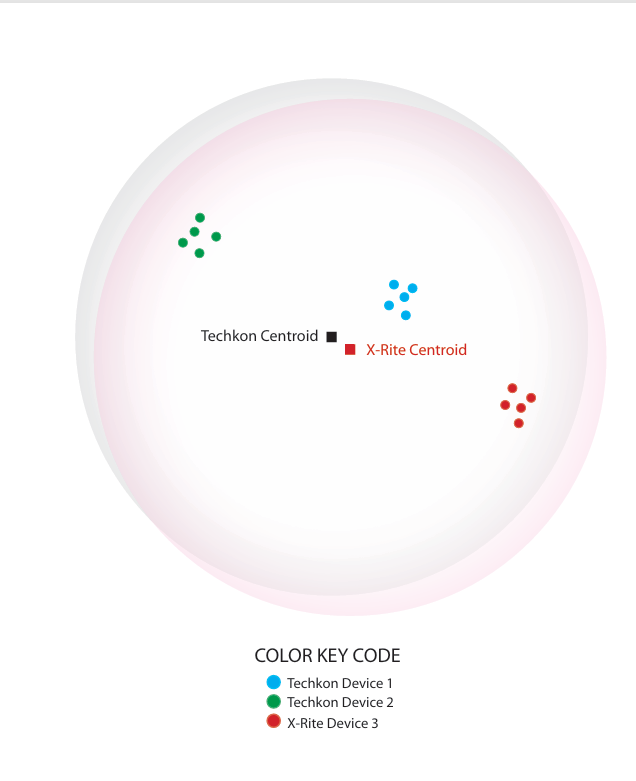
- Inter-Modal Agreement: When comparing instruments that have different measurement geometries (such as 0/45 and spherical d/8 geometries) it is common to see larger measurement differences depending on the characteristics of the sample. Because of this, you almost always see better consistency when looking at inter-instrument and intra-instrument agreement.
It is important to recognize that measurements taken by Spectro-Densitometers are affected by aperture size, instrument settings, calibration, and more.